
Interactive tool · Hand-arm vibration
Hand-arm vibration exposure calculator
This calculator estimates a day's hand-arm vibration exposure, A(8), and HSE exposure points from each tool's vibration magnitude and trigger time. It compares the result with the UK and EU daily exposure action value of 2.5 m/s² A(8) and limit value of 5 m/s² A(8), set by the Control of Vibration at Work Regulations 2005 and Directive 2002/44/EC. Typical tool values come from the UK Health and Safety Executive's L140 guidance (2019). The result is a planning estimate, not a measurement or a legal assessment.
By AccessoryFit editors · Checked
How do you use the vibration calculator?
Enter one row per tool used in the working day, with the time your hands are on that tool while it runs. The calculator does the rest with HSE's published formulas, and the result updates as you type.
- Choose the tool type Pick the closest tool type and inserted tool from the list, such as an angle grinder with a flap disc or a drill with a hole saw. Each option shows the HSE recommended initial value in m/s² beside its name. If you have a measured in-use value or a figure from the tool's manual that reflects how you use it, choose My own value and type it in.
- Enter the trigger time Trigger time is the time your hands are actually on the running tool, not the length of the job. A morning spent on a grinding task may contain far less trigger time than the clock suggests, so estimate it from short timed samples where you can.
- Add every tool used that day Use Add another tool for each extra tool. The calculator combines the tools the way HSE does, so a sander and a drill used in the same day give one daily figure.
- Read the two results Daily exposure A(8) is the legal measure, in m/s². Exposure points are HSE's simpler score, which can be added across tools. Both are compared with the action value and the limit value.
- Check the per-tool table The table shows each tool's points and how long that tool alone could run before reaching the action and limit values. Use it to see which tool or accessory dominates the day.
What is hand-arm vibration exposure?
Hand-arm vibration is the vibration passed into the hands and arms from powered tools, and UK and EU law limit how much of it a worker receives in a day. The legal measure is the daily exposure, A(8): it combines the tool's vibration magnitude, in metres per second squared, with the trigger time, and expresses the result as if it were spread over an eight-hour day.
Two things decide the figure. The first is the magnitude, which depends on the tool, the inserted accessory, its condition and how hard it is pushed. The second is time. Because both count, a low-vibration tool used all day can give a higher exposure than a harsh tool used for a few minutes, and a change of accessory can matter as much as a change of tool.
Long-term exposure is associated with hand-arm vibration syndrome (HAVS). This page does not describe its symptoms or diagnosis, because the fact base behind AccessoryFit holds no verified medical source for them; HSE's L140 guidance and an occupational health professional are the places to start.
What are the UK and EU vibration action and limit values?
The daily exposure action value is 2.5 m/s² A(8) and the daily exposure limit value is 5 m/s² A(8), in both the UK Control of Vibration at Work Regulations 2005 and EU Directive 2002/44/EC. Above the action value, employers must act to reduce exposure. The limit value must not be exceeded.
Where both hands are exposed, the UK regulations use the greater of the two hands' vibration magnitudes. That matters on tools such as angle grinders, where the side handle and the body grip can vibrate differently: a NIOSH database of grinder measurements under load shows the gap, with a peak of 23.4 m/s² (highest left-hand reading), and on every grinder in it the left-hand reading was higher than the right. The calculator follows that rule (the greater of two hands), so enter the figure for the worse hand when you have one.
The calculator labels each result in one of three bands: below the action value, above the action value, or above the limit value. Those labels apply the UK and EU thresholds only.
Is there a US limit for hand-arm vibration?
AccessoryFit could not confirm a US federal hand-arm vibration exposure limit. The research behind this page found no OSHA exposure limit and no ANSI S2.70 values in a primary document it could check, so none is stated here.
US measurement data do exist. NIOSH's power tools database, for example, records grinder handle vibration under load, and US and international studies of drilling report results against ISO 5349, the measurement standard for hand-transmitted vibration. A US reader can use the calculator to see where a day's work sits against the UK and EU values, as a reference point rather than a legal test.
How is daily vibration exposure A(8) calculated?
For a single tool, daily exposure is A(8) = a × √(T / 8), where a is the vibration magnitude in m/s² and T is the daily trigger time in hours. When several tools are used, HSE combines the partial exposures as A(8) = √(A1² + A2² + …) rather than adding them.
HSE's L140 also publishes an exposure points system, which is easier to add up on site. Each tool scores 2 × a² × T exposure points, with a and T in the same units as above, and the scores from different tools are simply added. In HSE's scale the action value equals 100 points (= EAV) and the limit value equals 400 points (= ELV). The limit is four times the action value in points because points rise with the square of vibration.
The square root in the A(8) formula leads to a common mistake. Halving the time on a tool does not halve A(8); it cuts it by less than a third. Exposure points, which scale directly with time, do halve. Reducing the magnitude, by choosing a lower-vibration tool or accessory, has a larger effect because magnitude is squared.
| Vibration magnitude (m/s²) | Time to EAV (hours) | Time to ELV (hours) |
|---|---|---|
| 2 | 12½ | >24 |
| 2.5 | 8 | >24 |
| 3 | 5½ | 22¼ |
| 4 | 3 | 12½ |
| 5 | 2 | 8 |
| 6 | 1½ | 5½ |
| 7 | 1 | 4 |
| 8 | ¾ | 3 |
| 10 | ½ | 2 |
| 14 | ¼ | 1 |
| 20 | 7 min | ½ |
L140 paragraph 103, Table 1, p. 32. Values as printed by HSE (rounded).
How much do common power tools vibrate?
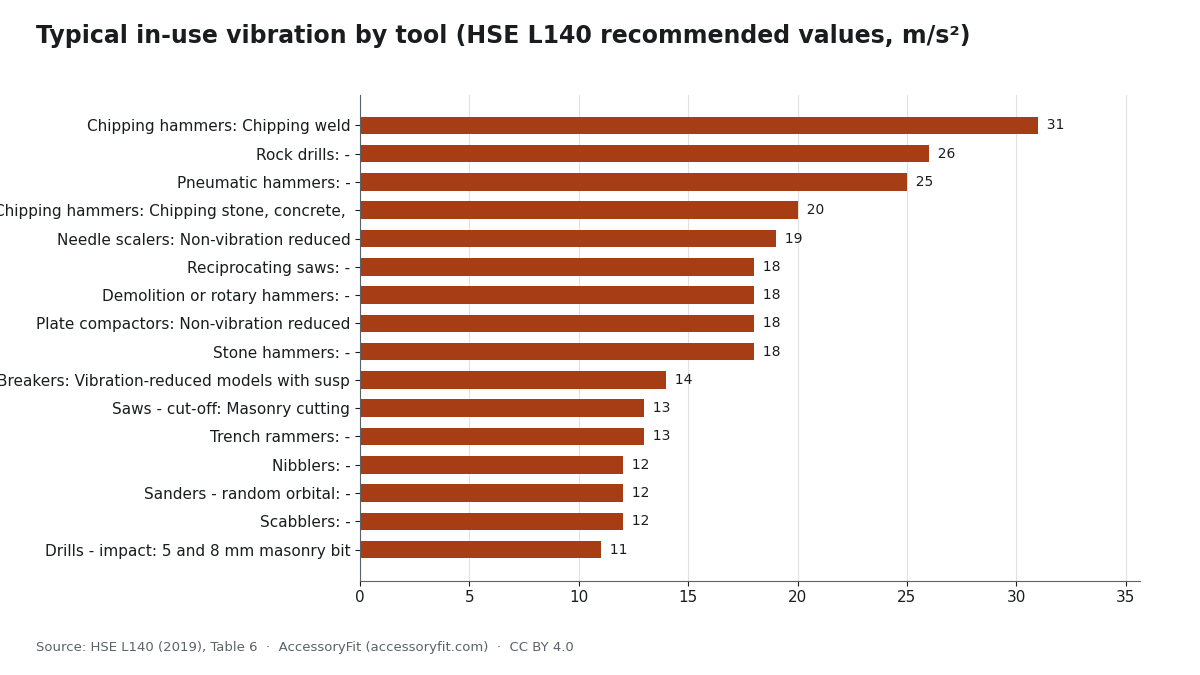
HSE's typical in-use values range from the low single figures for routers and polishers to well above the limit value for percussive tools such as chipping hammers and rock drills. The table below reproduces HSE's L140 Table 6: the range found in real use and a recommended initial value near the upper end of that range, which HSE suggests as a starting estimate when no better data exist. These are the values the calculator offers in its tool list.
Among the tools AccessoryFit covers, three of HSE's recommended initial values show the spread: 11 m/s² (jigsaw recommended initial value), 12 m/s² (random orbital sander recommended initial value) and, much lower, routers at 3 m/s². HSE notes that sander vibration depends strongly on applied force and the abrasive used. Impact drills with small masonry bits carry 11 m/s², and small to mid-size angle grinders carry 7 m/s².
| Industry | Tool type | Tool characteristic / inserted tool | Range lower, 10th pct (m/s²) | Range upper, 90th pct (m/s²) | Recommended initial value, 75th pct (m/s²) | Points per hour at recommended value | Trigger time to EAV | Trigger time to ELV | L140 page |
|---|---|---|---|---|---|---|---|---|---|
| General | Drills | Standard drill bit | 2 | 5 | 5 | 50 | 2.0 h | 8.0 h | p. 65 |
| General | Drills | Hole saw | 4 | 12 | 10 | 200 | 30 min | 2.0 h | p. 65 |
| General | Drills - core | 78-107 mm | 6 | 8 | 8 | 128 | 47 min | 3.1 h | p. 65 |
| General | Drills - impact | 5 and 8 mm masonry bit | 7 | 13 | 11 | 242 | 25 min | 1.7 h | p. 65 |
| General | Grinders - angle | 100-180 mm | 3 | 10 | 7 | 98 | 1.0 h | 4.1 h | p. 65 |
| General | Grinders - angle | 125 and 100 mm flapper discs | 2 | 5 | 4 | 32 | 3.1 h | 12.5 h | p. 65 |
| General | Grinders - angle | 220-300 mm | 4 | 11 | 9 | 162 | 37 min | 2.5 h | p. 66 |
| General | Grinders - die | - | 5 | 10 | 8 | 128 | 47 min | 3.1 h | p. 66 |
| General | Grinders - straight | - | 4 | 9 | 8 | 128 | 47 min | 3.1 h | p. 66 |
| General | Nail guns | - | 3 | 13 | 9 | 162 | 37 min | 2.5 h | p. 66 |
| General | Needle scalers | Non-vibration reduced | 12 | 26 | 19 | 722 | 8 min | 33 min | p. 66 |
| General | Needle scalers | Vibration reduced | 3 | 8 | 7 | 98 | 1.0 h | 4.1 h | p. 66 |
| General | Nibblers | - | 7 | 12 | 12 | 288 | 21 min | 1.4 h | p. 66 |
| General | Reciprocating saws | - | 7 | 27 | 18 | 648 | 9 min | 37 min | p. 66 |
| General | Sanders - random orbital | - | 6 | 14 | 12 | 288 | 21 min | 1.4 h | p. 66 |
| General | Sanders - orbital | - | 4 | 12 | 9 | 162 | 37 min | 2.5 h | p. 67 |
| Construction | Breakers | Vibration-reduced models with suspended handles or bodies | 7 | 18 | 14 | 392 | 15 min | 1.0 h | p. 67 |
| Construction | Demolition or rotary hammers | - | 10 | 21 | 18 | 648 | 9 min | 37 min | p. 67 |
| Construction | Plate compactors | Non-vibration reduced | 9 | 22 | 18 | 648 | 9 min | 37 min | p. 67 |
| Construction | Plate compactors | Vibration reduced | 2 | 7 | 4 | 32 | 3.1 h | 12.5 h | p. 67 |
| Construction | Pneumatic hammers | - | 10 | 29 | 25 | 1250 | 5 min | 19 min | p. 67 |
| Construction | Saws - cut-off | Masonry cutting | 5 | 14 | 13 | 338 | 18 min | 1.2 h | p. 67 |
| Construction | Scabblers | - | 4 | 14 | 12 | 288 | 21 min | 1.4 h | p. 67 |
| Construction | Trench rammers | - | 13 | 13 | 13 | 338 | 18 min | 1.2 h | p. 67 |
| Construction | Water-jetting guns | - | 1 | 5 | 4 | 32 | 3.1 h | 12.5 h | p. 67 |
| Forestry/horticulture | Brushcutters | Saw blade | 3 | 5 | 5 | 50 | 2.0 h | 8.0 h | p. 67 |
| Forestry/horticulture | Chainsaws | - | 5 | 7 | 7 | 98 | 1.0 h | 4.1 h | p. 67 |
| Forestry/horticulture | Hedge trimmers | - | 3 | 7 | 6 | 72 | 1.4 h | 5.6 h | p. 68 |
| Forestry/horticulture | Mowers - hand-guided | - | 4 | 8 | 7 | 98 | 1.0 h | 4.1 h | p. 68 |
| Forestry/horticulture | Mowers - ride-on | - | 3 | 7 | 6 | 72 | 1.4 h | 5.6 h | p. 68 |
| Forestry/horticulture | Strimmers | Brushcutter - strimmer | 2 | 7 | 7 | 98 | 1.0 h | 4.1 h | p. 68 |
| Engineering | Chipping hammers | Chipping weld | 20 | 32 | 31 | 1922 | 3 min | 12 min | p. 68 |
| Engineering | Impact wrenches | Drive size 3/8, 1/2 and 3/4 in | 3 | 6 | 5 | 50 | 2.0 h | 8.0 h | p. 68 |
| Engineering | Impact wrenches | Drive size 1 in | 7 | 11 | 10 | 200 | 30 min | 2.0 h | p. 68 |
| Engineering | Pedestal grinders | - | 2 | 11 | 8 | 128 | 47 min | 3.1 h | p. 68 |
| Engineering | Polishers - angle (hand-held) | Mop head or soft-backed pad | 1 | 3 | 3 | 18 | 5.6 h | 22.2 h | p. 68 |
| Stone working/mining/quarrying | Chipping hammers | Chipping stone, concrete, rust | 11 | 22 | 20 | 800 | 8 min | 30 min | p. 69 |
| Stone working/mining/quarrying | Rock drills | - | 10 | 28 | 26 | 1352 | 4 min | 18 min | p. 69 |
| Stone working/mining/quarrying | Stone hammers | - | 7 | 22 | 18 | 648 | 9 min | 37 min | p. 69 |
| Woodworking | Jigsaws | - | 9 | 17 | 11 | 242 | 25 min | 1.7 h | p. 69 |
| Woodworking | Routers | - | 2 | 3 | 3 | 18 | 5.6 h | 22.2 h | p. 69 |
| Woodworking | Staplers | - | 2 | 6 | 4 | 32 | 3.1 h | 12.5 h | p. 69 |
First six value columns and page are from L140 Table 6, which HSE says is based on common tool models in use before 2015. Points per hour (2a²) and times to EAV/ELV ((2.5/a)² x 8 h and (5/a)² x 8 h) are AccessoryFit calculations at the recommended initial value using L140 Equations 3, 4 and 7. HSE notes real values can exceed the recommended initial value.
Do accessories change how much a tool vibrates?
Yes. HSE's own table shows the inserted tool changing the starting estimate on the same machine. A drill running a hole saw carries 10 m/s², twice the figure for a standard drill bit. A small angle grinder fitted with a flap disc carries 4 m/s², below the 7 m/s² HSE gives grinders in general. HSE says worn bits, blunt blades, the wrong abrasive and pushing too hard all raise vibration.
Condition matters as well as type. In a 2017 Human Factors and Ergonomics Society bench study of a Hilti TE-70 hammer drill with two-cutter carbide masonry bits, drilling time per hole was 58% longer with worn bits than with new ones, and handle vibration rose slightly. More time per hole means more trigger time for the same work, which the calculator shows directly. The researchers behind that study and a 2017 Annals of Work Exposures and Health study recommend replacing masonry bits on a programme rather than pushing harder. A 2020 International Journal of Industrial Ergonomics study of a rotary hammer found that a lighter push allowed 17% more drilling per day within ISO 5349 vibration limits. For heavy drilling, the tool class matters too: see SDS-Plus versus SDS-Max for which rotary hammer bits suit which machine.
Fit is the other accessory factor. As the grinder disc size and arbor guide explains, a grinder disc whose hole or thread does not match the flange or spindle runs out of balance, vibrates excessively and can cause loss of control. On circular saws, the bore ring must match the blade's arbor hole, because the wrong ring can let the blade move and vibrate severely. Routers run with less vibration on a 1/2 in shank bit than on a smaller shank where the collet accepts it (the router collet size guide shows which routers take which shank), and keeping a reciprocating saw's shoe pressed on the work stops it jumping, which the reciprocating saw blade breakage checks cover.
How much grinding does it take to reach the action value?
About an hour of trigger time, on HSE's figures for a typical modern grinder. HSE says small, good-quality rotary tools such as angle grinders often vibrate at around 7 m/s², which gives roughly 1 hour to the action value (rotary tools at ~7 m/s²). Read across the 7 m/s² row of the time table above to see the limit-value time for the same tool.
Now change only the accessory. The same grinder fitted with a flap disc for finishing carries HSE's recommended value of 4 m/s². The 4 m/s² row of the time table shows how much longer that allows before each threshold, because the time to the action value scales with the inverse square of the magnitude. HSE's own example for a harsher tool gives 45 minutes to reach the action value at 8 m/s².
To combine tools, add their points. Take the Points per hour column of the tool table for each tool, multiply by the trigger hours, and add the results; the calculator above does the same sum and also converts it into A(8). If the total passes 100 points (= EAV), the day is above the action value. To try it, choose two tools in the calculator, set their times, and compare the per-tool rows to see which one to cut first.
Why might your real exposure differ from the estimate?
Real exposure can be higher or lower than the calculator shows, for four main reasons. First, HSE's table is based on tool models in common use before 2015, and its recommended values sit near the upper end of the measured range, not at the top of it, so some real uses measured higher. HSE notes real values can exceed the recommended initial value.
Second, manufacturers' declared values can understate in-use vibration. In HSE research report RR717 (Health and Safety Laboratory, 2009), declared values underestimated the in-use risk for 5 of 5 grinders tested, and front-handle readings on one grinder varied widely with the task. A 2026 Brazilian field study of welders using large angle grinders recorded normalised daily exposure at the rear handle as high as 10.5 m/s² (highest rear-handle reading), and every measurement in it passed the action value.
Third, trigger time is hard to estimate, and errors feed straight into the result. Fourth, accessory wear, the wrong abrasive and push force all shift the magnitude, as described above. HSE advises assuming the action value is likely exceeded when an estimate comes close to it.
The calculator's per-tool times assume that tool alone for the whole day. It is a planning aid for comparing tools, accessories and schedules; it does not replace a risk assessment, measurement or health surveillance.
Where do the calculator's values come from?
Every number on this page and in the tool list comes from published primary sources. The action and limit values come from regulation 4 of the Control of Vibration at Work Regulations 2005 and from Directive 2002/44/EC. The formulas, points system and tool values come from HSE's L140, second edition (2019), Appendix 1 and Appendix 3 Table 6. The points-per-hour and time-to-threshold columns in the tool table are AccessoryFit calculations at HSE's recommended initial value, using L140's own equations, and may differ slightly from HSE's rounded printed figures.
The calculator runs in your browser and sends nothing anywhere. All sources were checked on 22 October 2026 and are listed under References. Related figures on tool noise are in how loud power tools are, and the wider data set is collected under AccessoryFit research.
How do you cite this calculator?
Suggested citation: AccessoryFit, "Hand-arm vibration exposure calculator", updated 22 October 2026, https://accessoryfit.com/tools-interactive/vibration-exposure-calculator/. For the underlying tool values, cite HSE L140 (2019) as well.
The page text, tables and chart are free to reuse under the Creative Commons Attribution 4.0 licence (CC BY 4.0), including commercially, as long as you credit AccessoryFit and link to this page. The HSE values themselves remain HSE's; the licence covers AccessoryFit's presentation and calculated columns.
Download the data
The CSV reproduces HSE L140 Table 6 with AccessoryFit's calculated points per hour and times to the action and limit values; the chart is a PNG image. Both are free to reuse under CC BY 4.0 with credit to AccessoryFit and a link to this page; the underlying values remain HSE's.
- Hand-arm vibration by tool type, HSE L140 Table 6 (CSV) Range, recommended initial value, points per hour and time to the action and limit values for each tool type and inserted tool.
- Typical in-use vibration by tool (HSE L140) Bar chart of the highest recommended initial values in HSE's Table 6.
Questions readers ask
What is trigger time in a vibration assessment?
Trigger time is the time a worker's hands are in contact with the tool while it is running. It is usually much shorter than the time spent on the job, which is why HSE's formulas use it rather than shift length.
Should I use the vibration value in my tool's manual?
A manufacturer's declared value is a useful comparison between models, but HSE research report RR717 found declared values underestimated in-use risk for 5 of 5 grinders tested. A value measured in real use is better, and HSE's recommended initial value is the fallback when you have neither.
Does a flap disc vibrate less than a grinding wheel?
On HSE's figures, yes: 4 m/s² for small grinders with flap discs, against 7 m/s² for small and mid-size grinders in general. The disc's condition and the pressure applied still change the real figure.
Why does the calculator give two different results?
A(8) is the legal measure, expressed in m/s². Exposure points are HSE's simpler score: 100 points (= EAV) matches the action value and 400 points (= ELV) the limit value. Both come from the same inputs, so they always agree on which band the day falls in.
Can I use this calculator for whole-body vibration?
No. It covers hand-arm vibration only, using the hand-arm action and limit values. Whole-body vibration, from seats and standing platforms, is assessed separately and is not covered here.
Where to go next
- Angle grinder disc vibrationCauses and safety checks when a disc wobbles.
- Power tool noise levelsSound levels for the same tools, with hearing guidance.
- SDS-Plus vs SDS-MaxWhich rotary hammer bits fit which machine.
- Power tool research and dataAll AccessoryFit data pages and downloads.
References 121 documents, 26 publishers
- Bosch
- California DIR (Cal/OSHA)
- DeWalt
- DGUV Institute for Occupational Safety and Health (IFA)
- European Parliament and Council of the European Union
- FLEX (Chervon North America)
- Freud and Diablo
- HAZET
- Health and Safety Executive (UK)
- Human Factors and Ergonomics Society
- International Journal of Industrial Ergonomics (Elsevier)
- Klingspor
- Makita
- Milwaukee Tool
- NIOSH
- OSHA
- PFERD
- Revista Brasileira de Medicina do Trabalho (via PubMed Central)
- Saint-Gobain Abrasives (Norton)
- SKIL
- Stanley Black & Decker (IRWIN, LENOX)
- Surface Prep
- Timbecon
- UK Government, legislation.gov.uk (The National Archives)
- United Abrasives / SAIT
- Weiler Abrasives