Why a router bit burns or chips the wood, and how to fix it
A router bit usually burns wood because the feed is too slow or the bit is dull, and it chips or tears the surface when the pass is too heavy or the bit design lifts the face you need clean. Feed at a steady, moderate rate, take deep cuts in several passes, and route against the bit's rotation for control. Lower the speed for large bits. For tear-out on the top face, switch from an up-cut to a down-cut or compression spiral. Replace any bit that is dull, chipped or damaged rather than forcing it.
Burning comes from friction heat, mainly a feed that is too slow or a bit that has lost its edge. Chipping and tear-out come from the way the cutter meets the fibres: a dull edge, too much in one pass, or a bit whose flutes lift the surface you need clean. Feed direction belongs on the same checklist for control. Router manuals from Bosch, DeWalt and Milwaukee and bit makers' guides name the same short list. Speed set too high for the feed is a further cause named by one bit retailer, covered in the speed section below. The table pairs each symptom with its cause and fix.
Router burning and tear-out: symptoms, causes and fixes from router manuals and bit makers
Symptom
Likely cause
Fix
Burn marks along the cut
Feed too slow, or stopping mid-cut
Feed at a steady, moderate rate without lingering
Burning at a steady feed with a sharp bit
Speed too high for the feed (per ToolsToday)
Lower the speed, keep the feed, stay within the bit's rating
Motor labours, rough cut
Dull bit
Replace or resharpen; never use a dull or damaged bit
Motor stalls or bogs
Pass too deep, or feed too fast
Make several passes of increasing depth
Router pulls or runs ahead
Climb cutting (feeding with the rotation)
Feed against the rotation: left to right on an edge facing you
Tear-out on the top face
Up-cut spiral lifting the surface fibres
Use a down-cut or compression spiral
Splintering on panel faces
Bit design
Use a bit with shearing or down-cutting wings
02Does a slow feed rate make router bits burn?
Yes. Feeding too slowly leaves friction burns, and router manuals tell users to feed smoothly and steadily. The common belief that a slow feed gives the cleanest cut is the main reason people get scorch marks: the bit keeps rubbing the same wood instead of cutting fresh chips. Pausing at a corner, at the end of a board or to reposition your hands has the same effect.
How do you confirm it?
Burns that appear where you slowed down, such as at corners, starts and ends, point to feed rate. Burning along the whole length at a normal pace points instead to a dull bit or a pass that is too heavy.
How do you fix it?
Plan the cut so you can move through it in one steady motion, with hands and cord clear, and keep the stock moving past the bit on a router table rather than stopping to regrip. The same friction logic applies to saw blades; our page on fixing scorched cuts covers the blade version of the problem.
03How do you tell if the router bit is dull?
A dull bit makes the motor labour and needs more push to move through the cut, and manufacturers warn that the extra force can break the bit. The rule in router manuals is simple: never use dull or damaged bits. Look at the carbide edges under good light for rounding, chips or missing pieces.
When a correctly set-up bit still labours at a normal feed, it needs sharpening or replacement. The fact base behind this page holds no wear limit in hours or feet, so judge by how the bit cuts.
04Can taking too deep a cut cause burning and chipping?
Yes. A single heavy pass overloads the motor, slows the bit and invites both burning and rough, chipped edges. Router manuals tell users to take deep cuts in several passes of increasing depth instead.
For profiles, the same applies: rout a large round-over or ogee in two or three passes, raising the bit each time, rather than in one, so no single pass loads the motor heavily. Our guide to edge-profile router bits explains how each profile cuts and what it is used for.
05Does feed direction matter when a router burns or chips?
Yes, for control. Feeding the router the wrong way, called climb cutting, lets the bit pull the router along, and an uncontrolled cut is hard to keep at a steady feed. Seen from above, a hand-held router bit turns clockwise, so on an edge in front of you the router moves left to right. Go counterclockwise around the outside of a workpiece and clockwise around the inside.
Bosch, DeWalt and Milwaukee all tell users to avoid climb cutting because of the control risk. On a router table, feed the work against the bit's rotation as your table's manual specifies.
06Which spiral bit stops chipping on the top face?
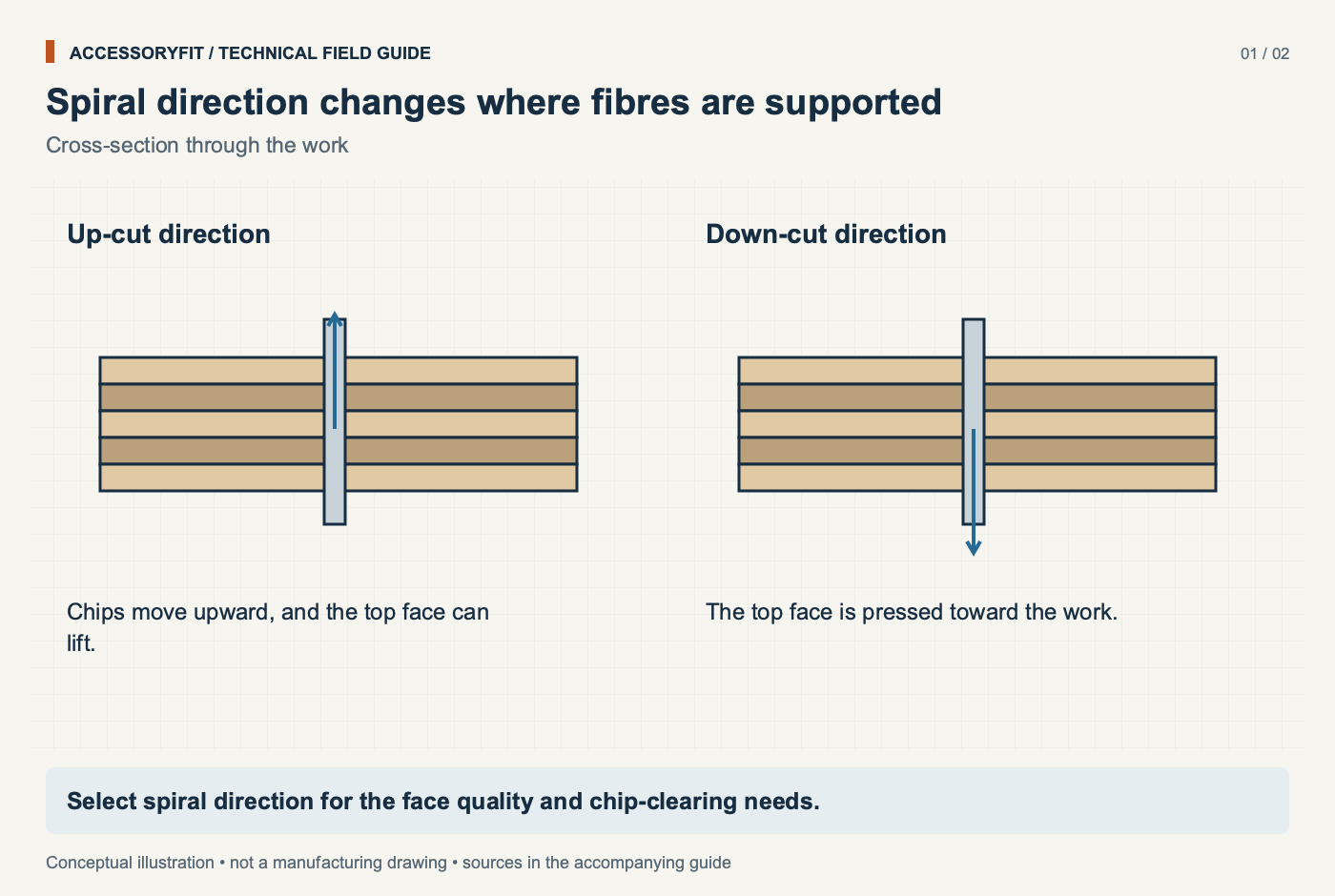
A down-cut or compression spiral. Up-cut spirals lift chips up and out of the cut, which suits deep cuts and mortises, but they leave more tear-out on the face nearest the router. Down-cut spirals push chips down and leave the cleanest edge on that near face, which suits shallow grooves, dadoes and inlays, though they clear chips more slowly. Compression spirals combine both flute directions to leave clean edges on both faces of sheet material.
A common misconception is that any spiral bit gives a clean top edge. It depends on the flute direction, so match it to the face that will show. In veneered plywood, where chipping on the top face is the usual complaint, the down-cut version is the one makers list for clean top edges. For raised panels and other large profiles, Freud's Quadra-Cut design uses shearing cutters to reduce splintering on panel faces.
Select spiral direction for the face quality and chip-clearing needs.
07Is router speed causing the burning?
It can be. ToolsToday, a router bit retailer, says running the bit too fast for the feed rate causes burning: each cutting edge takes a thinner chip, rubs instead of cutting and builds heat, so lowering the speed while keeping the same feed can reduce burning. That is one source's explanation, and it fits Freud's note that a bit making dust instead of chips dulls early because fine chips carry little heat away. Router manuals and bit makers also say to use lower speeds for larger-diameter bits and higher speeds for small bits.
In practice, check feed and sharpness first, because those are the causes the router manuals name. If the feed is already steady and the bit is sharp, try a lower dial setting at the same feed rate. CMT, a bit maker, adds that a bit's maximum speed depends on its diameter and application, that its chart's maximum falls as diameter rises, and that the speed marked on the bit or its packaging governs, so any change stays within that marking.
Speed also decides how soon an edge goes dull enough to burn. A 2016 Journal of Wood Science study milling melamine-faced particleboard ran an HSS cutter to a 1 mm flank-wear limit and recorded about 290 vs 1,000 m of cut at 18,000 rpm against 6,000 rpm. That is one lab setup in one sheet material, not a router-bit life rating, and it remains the most recent open-access speed-and-wear figure of its kind we found, but it shows why a bit run faster than the job needs can start scorching sooner. Once an edge has dulled, it also works the motor harder: in a 2024 BioResources test on a CNC router at 18,000 rpm, a blunt 16 mm carbide cutter needed about 51.6% more cutting power than a sharp one, so a bit that has started to burn may simply need sharpening or replacing.
Speed dials give a guide. On the Bosch 1617EVS, settings at the low end are listed for larger bits and the upper settings for smaller bits and softwoods; DeWalt's DWP611 manual groups its dial the same way. The table below shows the dial settings with their approximate speeds, from each maker's manual.
Router speed-dial settings and approximate rpm, from Bosch and DeWalt manuals
Bosch: the first setting is also listed for nonferrous metals. Bosch and DeWalt both say the bit maker's own speed recommendation should be followed.
08Is it safe to run a large bit at full router speed?
No. A bit run above its rated speed can break and fly apart, and Bosch, Makita and Freud state that a bit's rated speed must be at least the router's maximum speed. Whiteside's published ratings fall as cutting diameter rises, and large raised-panel bits are meant for router-table use at the reduced speed rated for the bit. Compact routers in our data run up to 27000 rpm (DeWalt DWP611) and 30000 rpm (Makita RT0701C), which is why the rating on the bit or its packaging must be read before fitting it. Compact routers also carry their own maximum bit diameter in the manual, so check that before fitting a large profile.
Routers in our data: collets and maximum no-load speed
Tool
Collets
No-load speed
Bosch 1617EVS
1/4, 3/8, 1/2, 8 mm in
25000 rpm one source
Bosch PR20EVS
1/4 in
35000 rpm
DeWalt DW618
1/4, 1/2 in one source
24000 rpm
DeWalt DWP611
1/4 in
27000 rpm
Makita RT0701C
1/4 in; 3/8 in
30000 rpm
Values marked one source appear in a single manufacturer document; check the tool's manual or rating plate before buying.
09Can the collet cause chatter, burning or chipping?
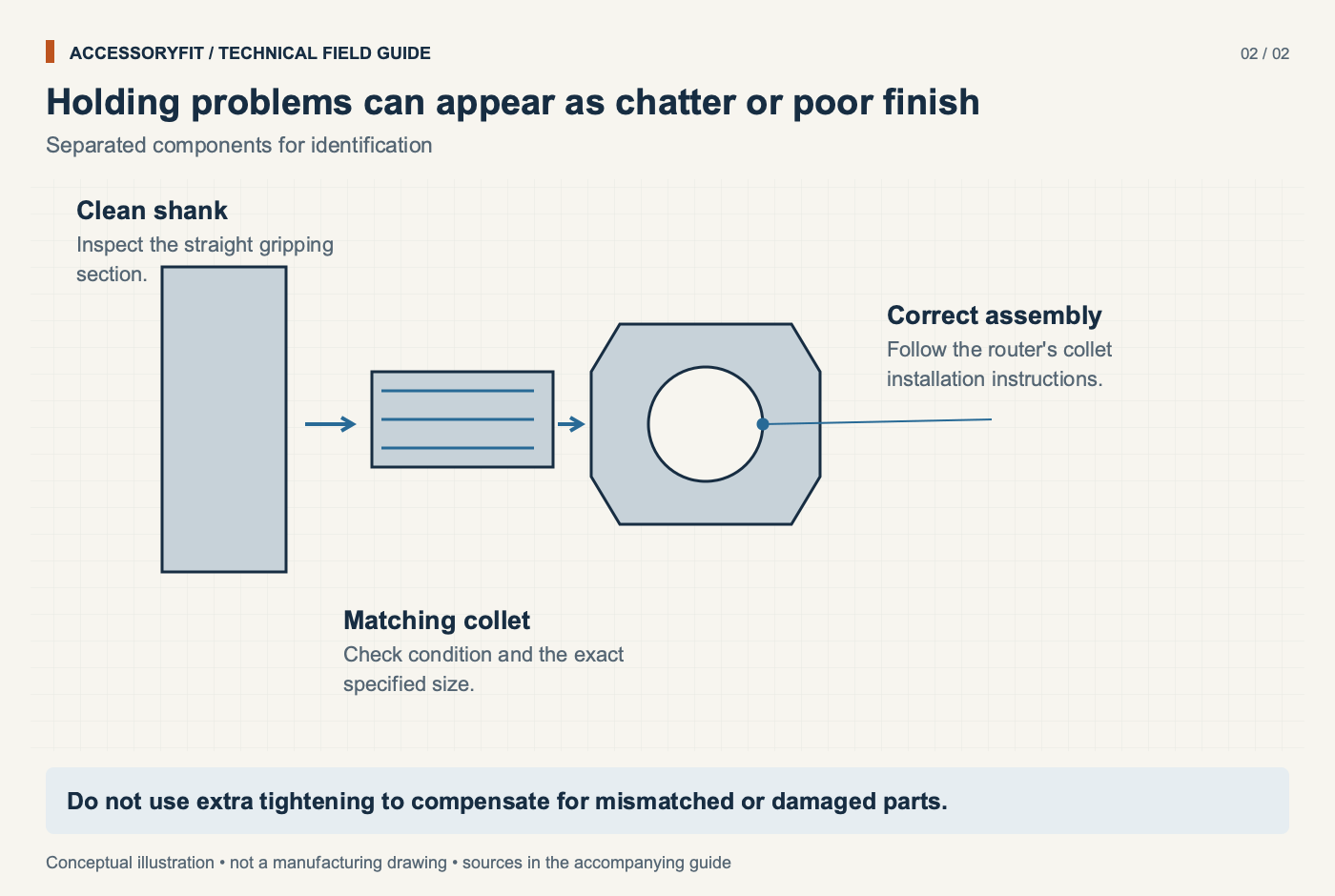
Yes, indirectly: a bit that is not held properly does not run true, and a mismatched collet may fail to grip or even break. Use a collet whose bore matches the shank exactly. An inch shank and the nearest metric shank are different sizes and are not interchangeable in the same collet, which corrects the idea that the two are close enough.
Bosch, DeWalt and Milwaukee all say to insert the bit fully and then back it out slightly so it does not bottom out, and Milwaukee adds that the collet must not clamp on the fluted part of the bit. Where the router accepts it, use a 1/2 in shank bit: larger shanks give more stability and less vibration than small ones. Compact routers from DeWalt, Milwaukee and Makita ship with a 1/4 in collet, while the Bosch 1617 family lists both inch and metric capacities. The router collet sizes guide lists the collets supplied with each model.
10How do you prevent burning and tear-out?
Most burning and chipping is prevented by a sharp bit, a steady feed in the right direction and passes light enough for the motor.
Inspect bits before each job and retire any that are dull, chipped or damaged.
Feed steadily; plan the cut so you do not stop partway.
Rout against the rotation: left to right on an edge facing you, counterclockwise around outside edges.
Take deep cuts and large profiles in several passes.
Lower the speed for large-diameter bits, within the bit's rating.
Pick spiral direction by the face that must stay clean.
Use the matching collet and seat the shank correctly.
11When should you replace the router bit?
Replace a bit when its carbide is chipped, cracked or missing, when it still labours and burns after you have corrected feed, depth and direction, or when it is the wrong design for the face you need clean. Damaged bits are not worth nursing along: they can snap or throw carbide.
The bits below cover the common jobs behind burn and chipping complaints: a straight bit for grooves, a round-over for edges, and an up-cut and down-cut spiral pair for choosing the clean face. Specs come from Freud's and Whiteside's product pages. Whiteside's speed figures for the up-cut spiral are confirmed by a second listing and shown below; for the other three bits, read the rating from the bit or its packaging. A starter set is another route, and our guide to router bit sets for beginners compares those.
12Which replacement router bits address burning and tear-out?
Product links go to Amazon. As an Amazon Associate I earn from qualifying purchases. How links are chosen.
Each bit below is carbide, with published dimensions from its maker. They are grouped by job, not ranked. Two have 1/4 in shanks for compact routers, and one has a 1/2 in shank for routers that accept it.
For clean top edges in veneer, laminate and plywood
Whiteside RD2100 1/4 in solid carbide down cut spiral bit
Cut diameter
1/4 in
Shank
1/4 in
Cutting length
1 in
Material
solid carbide
Spiral
down cut
Suits Shallow grooves, dadoes and inlays where the face nearest the router must stay chip-free.
Skip it if Deep mortises and slots, where chips need lifting out.
Down-cut flutes push fibres down for a clean near face
13What related routing problems appear alongside burning?
Burning often appears with chatter, a router that pulls, and stalling, because slow or uneven feed, climb cutting and heavy passes share the same root. Chatter and vibration also point to the bit holding: a small shank on a large cutter, or a shank seated wrongly in the collet. Tear-out on the exit edge of a board is a related but separate problem from top-face chipping.
Do not use extra tightening to compensate for mismatched or damaged parts.
14Questions readers ask
Why does my router burn the wood at the corners?
The feed slows or stops at the corner while the bit keeps turning in the same spot. Plan the cut so you move through the corner at a steady pace.
Which way should I move a hand-held router?
Against the bit's rotation. On an edge in front of you, move left to right; go counterclockwise around the outside of a workpiece and clockwise inside an opening.
Up-cut or down-cut spiral for plywood?
Down-cut leaves the cleaner face nearest the router; up-cut clears chips better but leaves more tear-out on that face. A compression spiral gives clean edges on both faces of sheet material.
Should I slow the router down to stop burning?
Check feed and sharpness first, since router manuals tie burning to slow feed and dull bits. If both are right, ToolsToday says a lower speed at the same feed can reduce burning. Keep speed within the bit's rating and lower for large bits.
Can a loose collet make a bit chip the wood?
A bit that is not gripped properly does not run true. Use the matching collet, seat the shank as the router manual says, and check the nut is tight after every bit change.
ABCM, COBEM 2005 proceedings: Influence of the Lubri-Cooling System on the Life of TiAlN Coated HSS Twist Drills when Machining Blind and Through Holes
Anglia Tool Centre (retailer): Trend T11EK 1/2 in router listing
Annals of Work Exposures and Health: The Effects of Bit Wear on Respirable Silica Dust, Noise and Productivity: A Hammer Drill Bench Study
Applied Ergonomics (Elsevier): Pneumatic rock drill vs. electric rotary hammer drill: Productivity, vibration, dust, and noise when drilling into concrete
BioResources: Effect of Chip Thickness and Tool Wear on Surface Roughness and Cutting Power during Up-Milling Wood of Different Density
CNC Router Store (retailer): Whiteside RU2100 up cut spiral listing
DeWalt: DWP611 compact router instruction manual (N336740); DWP611 1.25 HP max torque variable speed compact router with LED; DWE575 circular saw instruction manual (N786997), general power tool safety; DWP611 1-1/4 HP Max Torque Variable Speed Compact Router product page; DW616/DW618 Instruction Manual N384518; DW618 2-1/4 HP EVS Fixed Base Router With Soft Start product page
Festool: Collet SZ-D 8/OF 1010 (488755)
Freud and Diablo: Get the most out of your Freud bits by routing at ideal feed rates and speeds (CNC feed and speed sheet); 04-110 1/4 in Double Flute Straight Bit product page; 34-120 1/4 in Radius Rounding Over Bit product page
Health and Safety Executive (UK): Hand-arm vibration: The Control of Vibration at Work Regulations 2005. Guidance on Regulations (L140, Second edition)
Human Factors and Ergonomics Society: Construction Ergonomics: Concrete Bit Wear Increases Handle Vibration and Drilling Time
NIOSH: Nonfatal Tool- or Equipment-Related Injuries Treated in US Emergency Departments Among Workers in the Construction Industry, 1998-2005; Nonfatal work-related injuries treated in hospital emergency departments in the U.S., 2012-2023
OSHA: 29 CFR 1910.215 Abrasive wheel machinery; 29 CFR 1910.243 Guarding of portable powered tools; 29 CFR 1926.303 Abrasive wheels and tools; 29 CFR 1926.300 General requirements (Tools, hand and power); 29 CFR 1926.304 Woodworking tools
Power Tool Centre (retailer): Festool 488755 collet SZ-D 8/OF 1010 listing
Rockler: Rockler Pattern Flush Trim Router Bits - 1/2" Shank; Rockler Piloted Flush Trim Router Bits - 1/2" Shank
The Power Tool Store (retailer): Festool OF 1400 EQ-F-Plus router 578951 listing
ToolsToday: Is a flush trim bit the same as a pattern bit? (Q&A); Why Your CNC Router Bit Is Burning Wood (And Why Slowing Down Might Make It Worse); Router Safety: Best Practices for Safe, Precise, & Efficient Routing
Tribology in Industry: Comparison of Wear Behaviours of Cathodic Arc TiN, TiAlN Coated and Uncoated Twist Drills Under Aggressive Machining Conditions
Whiteside Machine Co.: 2016 roundover bit; 2210 roman ogee bit; 2310 45 degree chamfer bit; 3212 cove and bead bit; 1566 120 degree V-groove bit; D14-75 14 degree dovetail bit; RU7306 up cut spiral; RD7306 down cut spiral; UD7202 up/down cut (compression) spiral; 2415 flush trim bit; 6002 ogee stile and rail set; 5920B raised panel bit with back cutter; 1984 small pilot roundover; SC01 carbide straight bit; 1952 multi-rabbet bit set; 1074 straight bit; Steel router collet / reducer bushing 6400x10; RD2100 1/4 in down cut spiral product page; RU2100 1/4 in up cut spiral product page
Woodcraft: Freud 32-522 4 piece rabbeting router bit set with bearings, 1/2" shank; Freud 99-522 Quadra-Cut raised panel router bit, bevel, 1/2" shank